A
Experience our Helpdesk AI for 24/7 Facility Service Automation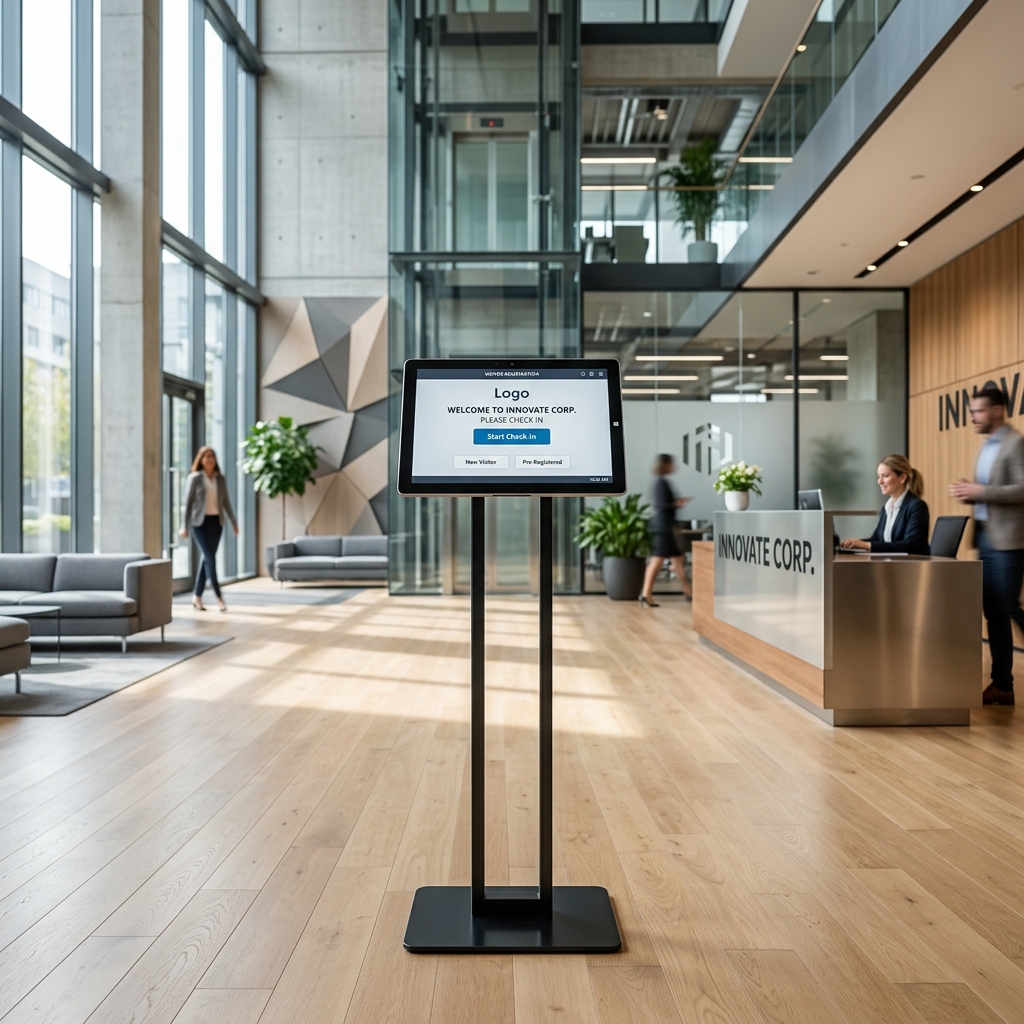
A visitor walks into a Riyadh office tower, signs a paper logbook nobody will ever read again, and gets waved through. If that's still how your front desk works, you don't have a security process — you have a guestbook. Visitor management solutions in Riyadh, Saudi Arabia now need to do a lot more: verify identity, notify the host, print a badge, log the exact time someone entered and left, and keep that data in a way that satisfies Saudi Arabia's PDPL. This guide walks through what to look for, what the market actually offers, and where visitor management fits inside a bigger facility strategy.
Riyadh's commercial footprint has changed fast. King Abdullah Financial District, new government campuses, expanding hospital networks, and a steady stream of Vision 2030 developments mean more buildings with more foot traffic and higher security expectations than five years ago. A sign-in sheet can't tell you who's still in the building during an evacuation. It can't flag a visitor who was denied entry last month. It can't produce an audit trail when a regulator or an internal investigation asks for one.
Government entities and NCA-regulated organizations feel this the most. Ministerial buildings, healthcare facilities, and critical infrastructure sites in Riyadh are expected to show exactly who accessed a site and when — not "probably around 2 or 3 pm." That expectation alone is pushing most mid-size and large facilities toward digital check-in, whether the driver is a security audit, an insurance requirement, or simply the embarrassment of losing a signed-in sheet.
Plenty of vendors sell a tablet at reception and call it done. A system built for Riyadh's compliance and security bar needs more than that.
Pre-registration and host notification. A host should be able to add a visitor's name, company, and purpose before they arrive, so security knows who to expect. The moment that visitor checks in, the host gets a message — not a phone call from the lobby.
ID and Iqama verification. Saudi Arabia's mixed population of citizens, residents, and international visitors means a visitor system needs to read national IDs, Iqamas, and passports without slowing the line down. Manual data entry defeats the purpose.
Photo capture and badge printing. A printed badge with a photo, visit purpose, and expiry time does two things: it deters people from wandering into areas they shouldn't, and it gives staff a fast visual check.
Watchlist and blacklist screening. If someone was denied access before, the system should catch that automatically at check-in, not rely on a security guard's memory.
Real-time occupancy and muster lists. In an emergency, someone needs to know exactly who's in the building right now. A live, exportable visitor list is not a nice-to-have — it's the difference between an orderly headcount and a guess.
Access control integration. The best setups don't stop at the lobby. A visitor badge that also triggers a turnstile, elevator access, or a specific floor permission closes the gap between "checked in" and "actually authorized to be there."
Every visitor system collects personal data — a name, an ID number, a photo, sometimes a vehicle plate. Under Saudi Arabia's Personal Data Protection Law, that makes your front desk a data controller, whether you've thought about it that way or not.
Before signing with any provider, ask three things directly: Where is the data hosted — inside the Kingdom or on a server somewhere else? What's the retention policy, and can you actually delete a visitor's record on request? And does the vendor have a documented process for consent and data access requests? A surprising number of visitor management tools built for other markets bolt on "GDPR compliance" and call it a day, without addressing PDPL's specific requirements around in-Kingdom hosting and government reporting. For a Riyadh deployment, that's not a minor gap — it's the difference between passing an audit and explaining to a regulator why visitor photos are sitting on a US or European cloud.
Here's the trap a lot of facility teams fall into: they buy a standalone visitor kiosk app, then separately run a CMMS for maintenance, a different system for access control, and a spreadsheet for space planning. Now there are four logins, four vendors, and zero shared data between them.
A visitor who checks in should show up as an occupancy data point your facility team can actually use — feeding into space utilization reports, tying into the same access control system that manages employee badges, and appearing in the same dashboard your security and operations teams already check. That's the case for treating visitor management as part of a broader CAFM or IWMS platform rather than a bolt-on app that talks to nothing else. Fewer systems to patch, fewer support contracts to manage, and one audit trail instead of three that don't match.
ADOX AI CAFM wasn't built as a standalone visitor kiosk — it's built as the operations layer for the whole facility, and visitor and access flow is part of that picture rather than sitting off to the side. A few things matter here for a Riyadh deployment specifically:
Data stays in the Kingdom, hosted on AWS Riyadh and Azure KSA, which is the starting point for any real PDPL conversation. The platform is Arabic-first with full RTL support, so front desk staff and security teams aren't working around a translated afterthought. It connects to the same Active Directory, BMS, and IoT integrations already running your building, so a visitor checking in can trigger the same access logic as an employee badge — no separate system to reconcile. And because it sits on the same AI layer that flags equipment anomalies, unusual visitor patterns — a badge trying repeated access outside expected hours, say — become another signal the Facility Copilot can surface, in Arabic or English, instead of something buried in a report nobody opens.
Before signing anything, run through this list:
If a vendor can't answer the first two questions clearly, it's worth walking away before the demo even starts.
What is a visitor management system and why does Riyadh need one? It's software that replaces paper sign-in sheets with digital check-in, ID verification, host notification, and badge printing. Riyadh's growth in government, healthcare, and commercial facilities has raised security and compliance expectations to the point where manual logs no longer hold up.
Is visitor management required under Saudi PDPL? PDPL doesn't name visitor management systems specifically, but any process that collects a visitor's name, ID, or photo counts as personal data processing. That means consent, data residency, and retention rules apply the same way they would to any other system handling personal information.
Can a visitor management system integrate with access control and CAFM software? Yes, and it should. The strongest setups link visitor check-in directly to turnstiles, elevator access, and the same platform running maintenance and space management, so visitor activity isn't sitting in a separate, disconnected app.
How long does it take to deploy a visitor management system in Riyadh? A standalone kiosk app can go live in days. A system integrated into a broader CAFM or IWMS platform, with access control and Active Directory sync, typically takes a few weeks depending on how many sites and integrations are involved.
Is Arabic support available for visitor management platforms in Riyadh? It should be standard, not an add-on. Front desk and security staff need a native Arabic, right-to-left interface — not a translated skin over an English-first product.
Riyadh's facilities have outgrown the guestbook. Whether you're managing one government building or a portfolio of hospitals, malls, and corporate towers across the city, visitor data deserves the same rigor as maintenance data, energy data, or space data — hosted locally, tied to your access control, and actually usable when someone asks a hard question.
[Book a demo with ADOX AI CAFM](https://cafmcloud.com/book-demo) to see how visitor and access management fits into a single facility platform built for Saudi Arabia.
Read more: How to Find the Best Visitor Management System in Riyadh, Saudi Arabia
Explore our full suite of Visitor Management Solutions in Saudi Arabia.
Join 500+ GCC enterprises using ADOX AI CAFM to reduce costs, eliminate downtime, and build smarter facilities. Deployment starts in 4 weeks.